We're not so different, you and I
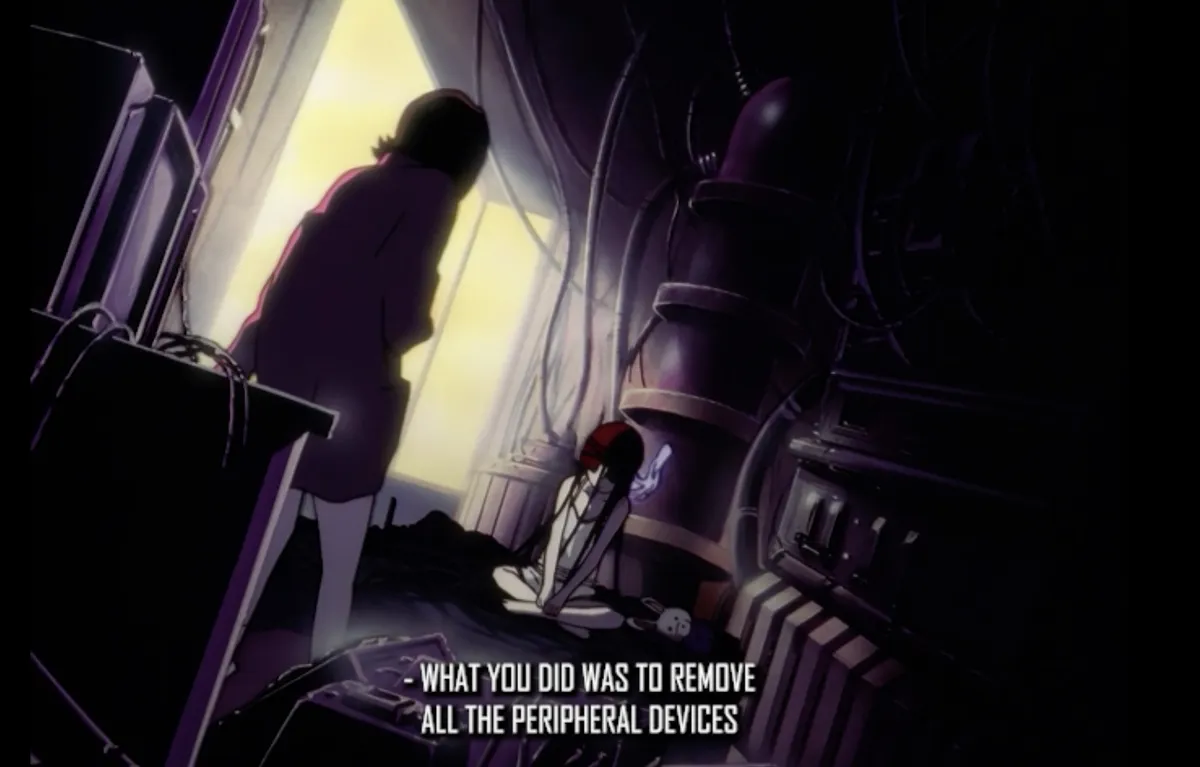
Lain: It's not a bug. What I don't understand, is you, god. What you did was remove all the peripheral devices that interact with the Wired. Phones, television, the network. But without those, you couldn't have accomplished anything.
Masami Eiri: Yes, Lain. Those are things that accompanied human evolution. But they are not an end themselves. Understand that humans who are more evolved than other forms of life have a right to exist with greater abilities.
Lain: But, wait a minute. Who gave you those rights? [...] The program that inserted code synched to the earth's characteristic frequency into the corresponding Protocol Seven code ultimately raised the collective unconscious to the conscious level. So tell me, did you honestly come up with these ideas on all by yourself?
Masami Eiri: What are you getting at? Are you telling me there's been a god all along?!
[...]
Lain (to Eiri): The Wired isn't an upper layer of the real world. When you were inside the Wired, you were god. Or so it seemed. But what about before the Wired ever came into existence? You were standing in for someone who was waiting for the Wired to reach its current state. You were just an acting god.1
We can read the above exchange from the denouement of Serial Experiments Lain (1998) as proof by mathematical induction that some final cause (to borrow Aristotelian language) over the use of human agency in order to surpass and control human agency in the future. Read in a strict way, this agency is at best illusory. We were never quite as in control as we believed.

The irony of Eiri's statement—"those are things that accompanied human evolution. But they are not an end themselves,"—comes home later in the scene: Eiri, too, is a stepping stone. He, too, is running about blindly as whatever is playing him is trying to "make it to level-2".2

The profundity of the tragic artist lies in this, that his aesthetic instinct surveys the more remote consequences, that he does not halt shortsightedly at what is closest to hand, that he affirms the large-scale economy which justifies the terrifying, the evil, the questionable— and more than merely justifies them [N III 575].
there is nothing
except
the impossible and not God [III 47].
Zero is immense.3
An interstitial question: What is time? This gave Augustine plenty of trouble. And after Kant, the trouble continues, if only for the fact that we can't think time in its totality. The time question, then, is bound up in that of the human more broadly, of our position in a changing, outstretched existence: time, in its fullness, concerns human subjectivity as much as destiny, or a destination.
On this, I take Nick Land as granting both:
(1) the transcendental character of time (Kant) and (2) the open character of subjectivity; that subjectivity opens onto a world, a cosmos, and one not fully in the grasp of our faculties.
This "opening up" gestures at Land's occult project. And so it comes as no surprise that with the subjectivity and time question he should bring up Carl Jung. It's been observed by more qualified people than myself that while Jung may have played the part of modern psychologist, he was, simply, doing occultism.4 In a recent conversation with Nance (of Three Billion Nances) and Michael Downs (of The Dangerous Maybe) concerning time, subjectivity, and the unconscious, Land issues the following remarks.5
Nick Land (henceforth NL): And I think all, wherever, whoever we think of as our guys are probably intermediate, and I honestly don't know where they stop. Like, I don't know where Žižek stops in this. I know that he would start out on the same journey. [...] I don't think he wants to go to the Wagnerian, Schopenharian, Vedantic absolute as the next stop.
Michael Downs (The Dangerous Maybe; henceforth MD): [Žižek] would be negative subjectivity, which is to say, I mean just for our purposes [...] we can think of the Freudian-Lacanian unconscious.
NL: And not the Jungian...
MD: I think [Žižek is] probably more against Jung than anybody.
NL: Yeah. Yeah. But it's interesting. Like, where, why you stop at one particular point, like, I mean how individuated is the Freudian unconscious?
How indeed? Though it may be wish fulfillment on my part, I'd say that Land is here engaging in a kind of hacker's game, something like a code injection, with "and not the Jungian [...] how individuated is...?" as the means to introducing an esoteric line of inquiry, a parallel process to accompany the conversation (and spin off from it). Land's provocation invites us to think the unconscious as something that Freud, Lacan, and Jung have some accurate, reasonable description of (I hope to write more deeply on this in future posts).
On the open character of subjectivity, Land challenges Kant's transcendental unity of apperception (why "unity" as opposed to "multiplicity"?). Whereas Kant is after a unifying, a priori ground for our reason (and hence our judgements), the notion of multiplicity suggests (at least on my reading) something like a distributed consciousness—a collective unconscious?
This invites another comparison: should we not take Land's syncretic view of mutually tense understandings of the unconscious in concert with another of Land's syncretisms?; namely, that between Marx and the Austrian School (again, Nance and Michael Downs have dealt with this in their reading of Teleoplexy).
Consequently, as basic co-components of capital, technology and economics have only a limited, formal distinctiveness under historical conditions of ignited capital escalation. The indissolubly twin-dynamic is techonomic (cross-excited commercial industrialism). Acceleration is techonomic time.6
Marxist critique might center concerns over the structurally-embedded subject in capitalism, while the challenge to Kantian subjectivity suggests a skepticism around the Marxist project—how does political subjectivity survive the identity shredder of capitalist production?. I take Land as gesturing to a conceptual through line connecting (1) the open subject (via the critique of Kant and psychoanalysis) and (2) an open cosmos (via "technomic time", the temporal matrix of capital and experience, the "teleoplex").
Land's syncretic challenges may function as a kind of speech act that forces us into a confrontation with subjectivity, both as a concept, and as experienced reality—however fraught that experience and conceptually impoverished that reality. Bringing to our faces our own fuzzy, middle position between unity and multiplicity, Land locates a recursive ignorance, our own gap that produces and asks of itself: how "individuated" are we, Freudian or otherwise? I (and I suspect in concert with Nance and Downs) take this revelation of the gap, of the distributed, dislocated subject, as being vital for navigating the linkages between the bold question of the unconscious with the comparably bold question of "technomic time", nature, capital, and the social (to borrow from Chris Cutrone's lectures)7 ; it may well be that we're all Masami Eiri, we're all Rick Deckard, convinced as hell as we try "to get a grip."
What are we to do with our conviction?
Serial Experiments Lain, Layer 12: "Landscape" (1998)↩
Nick Land, Meltdown, published on Virtual Futures↩
Epigraph to Nick Land, Thirst for Annihilation: Georges Bataille and virulent nihilism (an essay in atheistic religion) (1992)↩
I'd guess that the (fairly) casual reader of Ouspensky would plainly see this about Jung as well. Along with John Michael Greer, I must credit James Ellis of the Hermitix podcast for stressing both the point about Jung's occultism and the importance of Ouspensky as an occult documentarian of sorts. See: John Michael Greer, Carl Jung, Occultist.↩
Nick Land, Teleoplexy, published in the Accelerate: The Accelerationist Reader (2014, Urbanomic)↩
With all this loose talk of Lacan, gaps, and subjectivity, it would be irresponsible of me to not reference an emerging disagreement (I want to say "discussion" as well) between Rafael Holmberg and Slavoj Zizek on, let's say, the metaphysical validity of Lacanian concept of Lack. See: Holmberg's recent piece Hypercompleteness: Reply to Žižek. There, Holmberg writes:
Unlike Žižek, who argues that reality is ontologically incomplete, I argue that incompleteness fails to grasp the true contradiction of reality: rather than just ‘missing a piece’, reality occupies incompatible, mutually exclusive positions. Reality is “hypercomplete”: it ontologically presupposes a ‘more than itself’ which is not merely the counterpart to (but rather than irreducible to) incompleteness. See also: Žižek's essay in Crisis & Critique.↩